
Smart Panels in 2026: Who They’re Actually For (And Who Doesn’t Need One)

Smart Panels in 2026: Who They’re Actually For (And Who Doesn’t Need One)
“Smart panel” is one of those terms that gets used a lot, but it can mean very different things depending on the system.
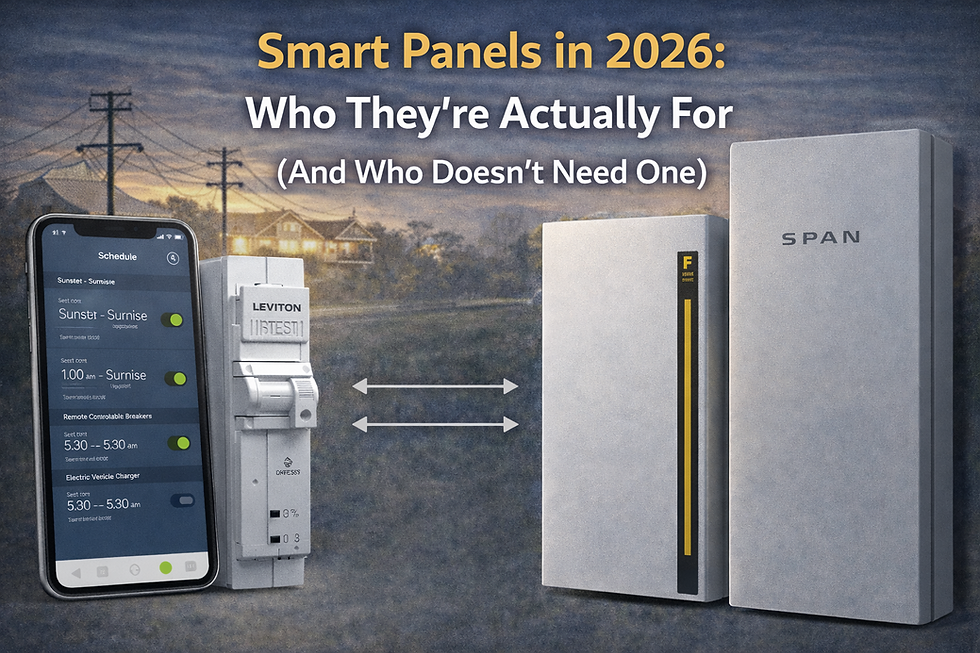
Some smart panels focus on monitoring and app control. Others include a true Energy Management System (EMS)that can actively manage electrical loads in real time.
In 2026, especially here on the Central Coast where more homes are adding EVs, heat pumps, batteries, and all-electric appliances, that difference matters. Choosing the right approach can save money and avoid unnecessary upgrades. Choosing the wrong one can add cost without solving the real problem.
This guide breaks it down clearly.
Two Categories of Smart Panels in 2026
1. Smart Panels Focused on Monitoring and App Control
This category uses smart breakers and software to give homeowners visibility and control over their electrical system.

Key features typically include:
circuit-level energy monitoring
usage history and trends
notifications and alerts
remote on/off control for individual circuits
This approach is well-suited for homeowners who want insight into how their electricity is used and the convenience of app-based control.
To install this type of system, the electrical panel must be compatible with the smart breakers being used, which usually means installing a matching panel and then populating it with smart breakers.
What this type of smart panel does well:
helps homeowners understand energy use
provides convenience and control
supports informed energy decisions
What it does not do on its own:
actively manage total electrical demand
shed loads automatically to prevent overload
change how much load the home is allowed to carry
2. Smart Panels With an Energy Management System (EMS)
An EMS-based smart panel includes monitoring and control, plus the ability to actively manage loads.
This means the panel can:
measure total electrical demand in real time
prioritize circuits based on homeowner settings
automatically pause or shed lower-priority loads
prevent the home from exceeding safe limits
This is a fundamentally different capability. Instead of just showing you what’s happening, an EMS panel can control how electricity is used when demand spikes.
Panels like SPAN fall into this category.
Why EMS Matters for EVs and Electrification
When homeowners ask, “Can I add an EV charger?” or “Can I go all-electric?” the real question is usually about capacity.

Adding loads like:
Level 2 EV chargers
electric ovens
heat pumps
electric water heaters
can push a home beyond what its electrical service can safely support.
Without load management, the options are often limited to:
upgrading the service or panel capacity, or
reworking circuits and loads
With an EMS-based smart panel, it may be possible to add those loads because the system can actively manage demand, trimming or pausing lower-priority loads when necessary.
That’s what allows an EMS panel to unlock electrification projects that would otherwise require major upgrades.
Why Underground Services Change the Economics
Homes with underground electrical service often face much higher costs when a service upgrade is required. Those upgrades can involve:
trenching
conduit installation
long wire runs
coordination with the utility
repairs to concrete, driveways, or landscaping
In the right situation, an EMS-based smart panel can avoid or delay those upgrades by keeping demand within allowable limits through intelligent load control.
This is one of the scenarios where a smart panel can save tens of thousands of dollars, depending on site conditions.
When Monitoring-Focused Smart Panels Make Sense
Monitoring and app-control systems can be a great fit when:
the home already has adequate service capacity
electrical demand is stable and predictable
no major new loads are being added
the homeowner wants insight and convenience
automatic load shedding isn’t needed
In these cases, adding monitoring without full load management can be the right balance between functionality and cost.
When an EMS Smart Panel Is the Right Tool
An EMS-based smart panel tends to make sense when:
EV charging is being added to a near-capacity system
multiple large electric loads are planned
electrification will happen gradually over time
underground service upgrades would be expensive
flexibility and future planning matter
Here, load control isn’t a “nice-to-have” — it’s what makes the project possible.
When a Smart Panel Isn’t Necessary
Not every home benefits from smart technology.
A smart panel may be unnecessary when:
the home has plenty of spare capacity
electrical usage is simple
no EVs or major electric appliances are planned
the existing panel and wiring are in good condition
In those cases, a standard panel upgrade or targeted circuit work may be the most sensible solution.
Sometimes the smartest move is simply installing solid, properly sized equipment without added complexity.
Why Load Calculations Come First
Before recommending any solution, the most important step is a load calculation and system evaluation.

That tells us:
what the home is currently designed to handle
how much additional load can be added safely
whether monitoring, load management, or a capacity upgrade is needed
From there, the solution becomes clear — and homeowners avoid overspending on equipment they don’t actually need.
The Bottom Line for Central Coast Homes
In 2026, “smart panel” can mean either:
monitoring and app-based control, or
true energy management with active load control
The difference matters because EMS-based panels can change what a home is allowed to support — especially when EVs and electrification are involved.
But if a home has ample capacity and stable usage, simpler solutions are often the better choice.
The goal isn’t more technology.
It’s an electrical system that’s safe, efficient, and aligned with how you live now and plan to live next.


Comments